BBN Generation
BBN generation is available in py-scm. We support singly- and multi-connected Gaussian BBNs.
Singly-connected BBN
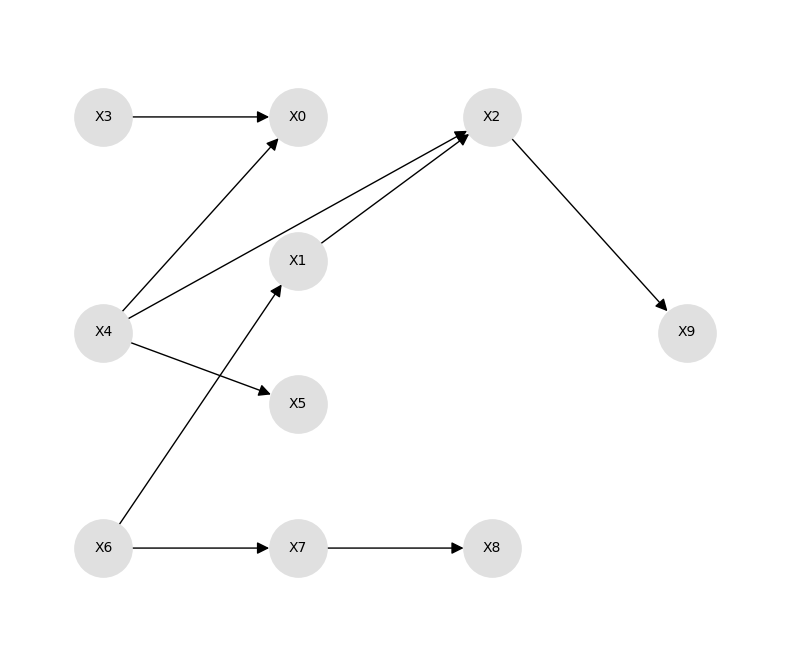
Use generate_singly_gaussian_bbn() to generate a singly-connected Gaussian BBN and then use create_reasoning_model() to create a reasoning model.
This example uses max_iter=20 so the generated tree is more illustrative than the initial ordered chain.
[1]:
from help.viz import get_graph_layout, to_networkx
import matplotlib.pyplot as plt
import networkx as nx
from pyscm.generator import generate_singly_gaussian_bbn
from pyscm.reasoning import create_reasoning_model

generated = generate_singly_gaussian_bbn(
    n=10,
    max_iter=20,
    seed=37,
    max_degree=3,
    max_condition_number=25.0,
)

g = generated.graph
p = generated.parameters

model = create_reasoning_model(g, p)
The singly-connected BBN graph looks like the following.
[2]:
dag = to_networkx(g)

fig, ax = plt.subplots(figsize=(8.0, 6.75))

pos = get_graph_layout(dag, seed=37)
nx.draw(
    dag,
    pos=pos,
    with_labels=True,
    node_color="#e0e0e0",
    node_size=1700,
    font_size=10,
    arrows=True,
    arrowsize=18,
    ax=ax,
)

ax.margins(x=0.10, y=0.18)
fig.tight_layout()
Posterior queries proceed as usual.
[3]:
means, covariance = model.pquery({"X1": 0.5}, pandas=True)
means.to_frame("mean")
[3]:
| mean | |
|---|---|
| X0 | 0.448743 |
| X1 | 0.500000 |
| X2 | 0.235416 |
| X3 | -0.670662 |
| X4 | -0.602994 |
| X5 | -0.064449 |
| X6 | 0.261791 |
| X7 | 0.194697 |
| X8 | -0.158753 |
| X9 | 0.323203 |
[4]:
model.iquery("X9", {"X1": 1.25}, pandas=True)
[4]:
mean    0.346223
std     0.445736
dtype: float64
Multi-connected BBN
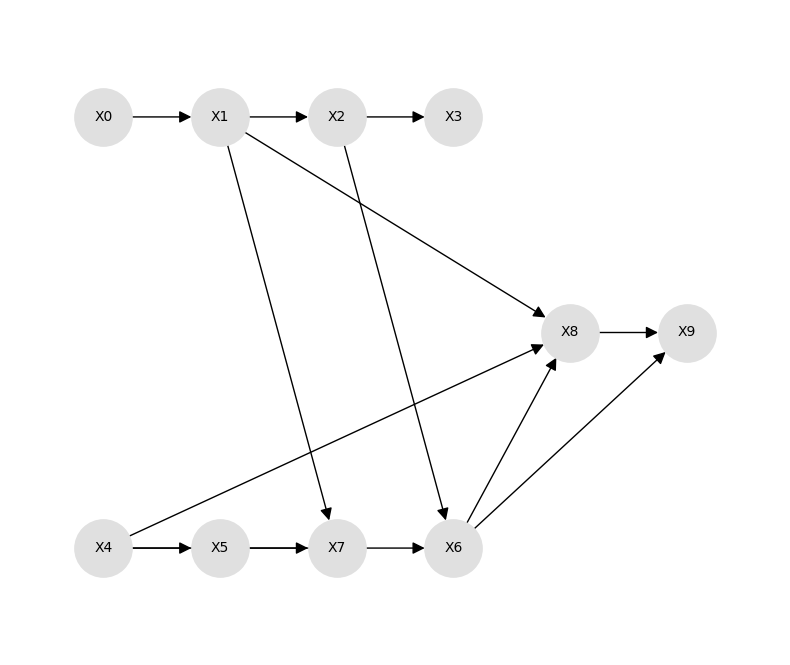
Use generate_multi_gaussian_bbn() to generate a multi-connected Gaussian BBN and then use create_reasoning_model() to create a reasoning model.
This example also uses max_iter=20, and the fixed seed below keeps the example reproducible while avoiding a near-chain structure.
[5]:
from pyscm.generator import generate_multi_gaussian_bbn

generated = generate_multi_gaussian_bbn(
    n=10,
    max_iter=20,
    seed=3,
    max_degree=4,
    intercept_mean=0.25,
    intercept_sd=0.2,
    weight_mean=0.0,
    weight_sd=0.3,
    noise_sd_min=0.4,
    noise_sd_max=0.8,
    max_condition_number=25.0,
)

g = generated.graph
p = generated.parameters

model = create_reasoning_model(g, p)
The multi-connected BBN graph looks like the following.
[6]:
dag = to_networkx(g)

fig, ax = plt.subplots(figsize=(8.0, 6.75))

pos = get_graph_layout(dag, seed=37)
nx.draw(
    dag,
    pos=pos,
    with_labels=True,
    node_color="#e0e0e0",
    node_size=1700,
    font_size=10,
    arrows=True,
    arrowsize=18,
    ax=ax,
)

ax.margins(x=0.10, y=0.18)
fig.tight_layout()
[7]:
model.equery("X9", {"X1": 1.0}, {"X1": -1.0}, pandas=True)
[7]:
mean   -0.065951
std     0.000000
dtype: float64
[8]:
model.samples(size=10).head()
[8]:
| X0 | X1 | X2 | X3 | X4 | X5 | X6 | X7 | X8 | X9 | |
|---|---|---|---|---|---|---|---|---|---|---|
| 0 | -0.556711 | 1.441756 | 1.197602 | 1.866988 | 1.280589 | 1.494780 | 0.098026 | -1.253835 | 1.353719 | -0.212623 |
| 1 | -0.197582 | 0.442962 | 0.409467 | 0.598435 | 0.287417 | -0.534240 | -0.379872 | -0.264745 | -0.311271 | -1.134408 |
| 2 | 0.932308 | -0.675724 | 0.050717 | -0.025196 | 1.192979 | 0.476395 | 0.155484 | 0.517682 | 0.180630 | 1.389682 |
| 3 | 0.999141 | 0.412904 | 0.997719 | 0.746910 | 1.027509 | -0.066919 | 0.186078 | -0.061389 | -0.409386 | 0.091236 |
| 4 | 0.063324 | 0.269446 | 0.948745 | 0.565484 | 0.967308 | -0.756124 | -0.774144 | -0.307976 | -0.050875 | 1.624334 |